

On Thursday, August 21, 2025, the National Institute of Statistical Sciences (NISS) hosted a Virtual Thought Summit bringing together leading experts to discuss how data science is transforming our understanding of environmental impacts on public health. The event served as a prelude to the upcoming IMSI+NISS Ideas Lab Workshop on Data Science at the Intersection of Public Health and the Environment, to be held in Chicago, October 20–24, 2025.
The summit featured a panel of invited experts, each offering insights into emerging challenges and opportunities at the nexus of environmental science, data science, and public health:
- Jonathan Hobbs (Jet Propulsion Laboratory) – highlighted how satellite-based Earth observation systems are being leveraged to monitor environmental health indicators and inform strategies for protecting population health, noting upcoming NASA missions such as Maya and TEMPO.
- Chris Wikle (University of Missouri) – shared advances in spatio-temporal modeling to capture the complexity of environmental systems, their interactions with human health, and the importance of linking extreme events to causal inference.
- Marianthi-Anna Kioumourtzoglou (Brown University) – explored data-driven methods in environmental epidemiology, integrating heterogeneous data sources, machine learning, and statistical innovations to uncover links between pollution exposure and population-level health outcomes.
The discussion was moderated by Bo Li, Stanley A. Sawyer Professor in the Department of Statistics and Data Science and Co-director of the Transdisciplinary Institute in Applied Data Sciences at Washington University in St. Louis.
Opening Insights and Emerging Challenges
Following introductory remarks, panelists underscored the role of satellite data in environmental health monitoring, machine learning for predicting air pollution exposure, and advanced statistical models for capturing the spatio-temporal variability of health and climate data. They emphasized the importance of uncertainty quantification, noting its relevance in areas such as wildfire prediction, air quality alerts, and real-time health risk assessments.
Panelists also discussed data integration challenges, particularly the difficulty of linking diverse data sources—satellite imagery, surveys, registries, and environmental monitoring systems—while protecting privacy and addressing gaps in temporal and spatial resolution. The concept of Digital Twins was highlighted as a promising tool to fuse mechanistic models with real-world data for applications ranging from wildfire response to urban heatwave preparedness.
Interdisciplinary Collaboration and Policy Relevance
The conversation highlighted the challenges of interdisciplinary teamwork, where terminology and methodological differences across statistics, computer science, epidemiology, and environmental engineering often create communication barriers. Panelists stressed the importance of building shared understanding while ensuring research outputs remain relevant to policy and public health practice.
Marianthi-Anna noted the complexities of translating research into regulatory action, particularly in the current political climate, and encouraged community-driven approaches while maintaining consistency with broader scientific trends.
Key Themes Emerging from the Discussion
- The power of Earth observation and remote sensing to provide scalable, high-resolution environmental health indicators.
- The importance of spatio-temporal statistical models for linking environmental variability with human health outcomes.
- Strengthening environmental epidemiology through interdisciplinary collaboration.
- Balancing methodological innovation with policy relevance to ensure impact on decision-making.
- The need for new frameworks to co-model rare and extreme events (wildfires, floods, pandemics) across human and environmental systems.
- Growing urgency to address the “data science without data” paradox, where methodological innovation outpaces robust data collection and sharing.
Recommendations and Next Steps
The panel identified several opportunities for advancing the field:
- Integrate diverse datasets (satellite, health registries, environmental monitoring, surveys) to build comprehensive environment-health linkages.
- Develop new inferential frameworks to strengthen causal analysis in complex, multi-level systems.
- Advance co-modeling of extremes to improve preparedness for climate-related and public health crises.
- Promote innovative sampling strategies to reduce bias, enhance representativeness, and address data gaps.
- Encourage stronger interdisciplinary collaboration to align statistical methods with real-world applications in public health and policy.
- Invest in uncertainty quantification and digital twin technologies to strengthen predictive capacity and resilience.
- Expand funding opportunities beyond NIH, leveraging foundations and international initiatives, while addressing disparities in low- and middle-income contexts.
Connecting to the IMSI+NISS Ideas Lab Workshop (October 20–24, 2025)
The August Thought Summit served as a launchpad for the upcoming IMSI+NISS Ideas Lab Workshop in Chicago, which will gather experts from across disciplines to develop collaborative research initiatives in five priority areas:
- New inferential approaches for linking and analyzing diverse datasets.
- Species abundance and diversity modeling for assessing ecosystem and biodiversity health.
- Innovative sampling techniques to quantify variability, bias, and uncertainty.
- Co-modeling of extremes in environmental and human health domains.
- Mathematical modeling of environmental systems to identify tipping points and intervention strategies.
Together, the Thought Summit and the October Ideas Lab underscore NISS’s mission to advance data-driven insights at the intersection of science, health, and society, positioning data science as a vital tool for addressing the most pressing environmental and public health challenges of our time. NISS and IMSI extends its sincere gratitude to our moderator, Bo Li (Washington University in St. Louis), and to our panelists—Jonathan Hobbs (JPL), Chris Wikle (University of Missouri), and Marianthi-Anna Kioumourtzoglou (Brown University)—for sharing their expertise and sparking a thoughtful discussion at the Virtual Thought Summit. We also thank the IMSI team and the broader NISS community for their continued collaboration in shaping this important dialogue at the intersection of data science, environmental science, and public health.
About the Data Science at the Intersection of Public Health and the Environment - Ideas Lab (Workshop)
Overview
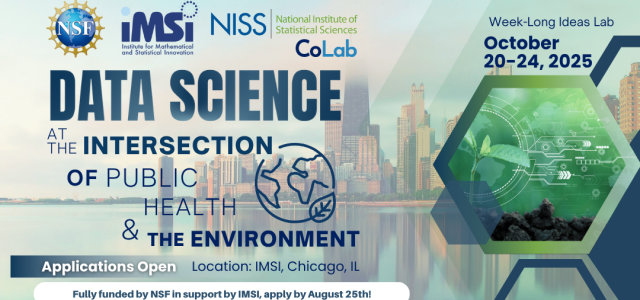
IMSI and the National Institute of Statistical Sciences (NISS) are organizing a workshop on Data Science at the Intersection of Public Health and the Environment. This event will bring together experts from diverse fields to explore innovative methodologies, foster collaboration, and address pressing challenges in public and environmental health using data science techniques.
Download Flyer:  Flyer 8.5x11 IMSI-NISS Data Science Health & Environment.pdf
See full details on event page: Data Science at the Intersection of Public Health and the Environment - Ideas Lab (Workshop)
Key Research Areas:
- New inferential approaches: Summarizing, linking, and analyzing diverse datasets from epidemiological studies, health registries, environmental monitoring, and surveys to uncover shared patterns, trends, associations, and causal relationships.
- Species abundance and diversity modeling: Leveraging big data to assess ecosystem and biodiversity health across different spatial and temporal resolutions.
- Innovative sampling techniques: Designing efficient and representative data collection methods while quantifying variability, bias, and uncertainty in joint environmental and health studies.
- Co-modeling of extremes: Developing methodologies to model the probability and magnitude of rare events in both environmental and human health domains (e.g., floods, wildfires, droughts, pandemics, food insecurity).
- Mathematical modeling of environmental systems: Simulating biological, physical, and chemical processes, hypothesizing tipping points, and integrating causal models to assess intervention impacts.
About the Intersection of Public Health & the Environment
Human-natural systems are increasingly interconnected. Data-driven science and engineering enhance our understanding of these complex processes. The intersection of Public Health and the Environment is among the most systemically important - each facing its own urgent crises, and with growing spillover of negative environmental outcomes influencing negative human health outcomes, in particular. Mathematical and Statistical tools are essential for understanding and addressing the complex and interrelated challenges of public and environmental health. Emergent data sources coupled with modern methods have great promise to help mitigate future risks, but transdisciplinary methodological innovations are required to comprehensively address multi-faced challenges.
Data-driven research directions at the intersection of public health and the environment
- New descriptive and inferential approaches are needed to help summarize, interpret, link, and then analyze data across a spectrum of diverse sources, from epidemiological studies and health registries to environmental monitoring and surveys. These will enable discovery of shared patterns, trends, associations, and even causal relationships between environmental factors and health outcomes.
- New species abundance, richness, and diversity models harvested through big data can help measure and contrast ecosystem and biodiversity health across spatial and temporal resolutions. They will also help assess human, climate, and invasive species impacts on the environment.
- New sampling techniques can help design and optimize efficient and representative data collection methods for joint environmental and health studies, and provide new means for quantifying variability, bias, and greater uncertainty.
- Advances in the co-modeling of extremes is essential to holistically model both the probability and size of rare events across the environment and human health, from fires, floods, plant and animal imbalance, and droughts to malnutrition, water and food insecurity, epidemics, and pandemics. They can further lead to the discovery of additional unrealized and unknown risks across public and environmental health.
- Advanced mathematical modeling of the environment can help simulate dynamics and interactions of biological, physical, and chemical processes for the future environment. Tipping points can be hypothesized, and when coupled with causal models for health outcomes, the effects of different interventions and policies on diverse scenarios can be studied as robustness and resiliency is further integrated into environmental and health systems.